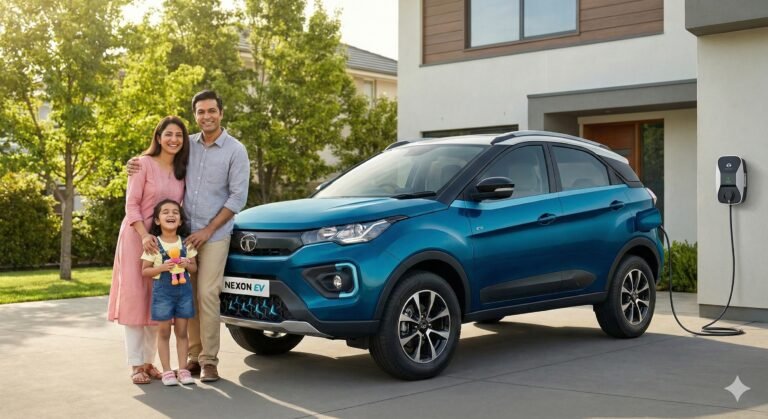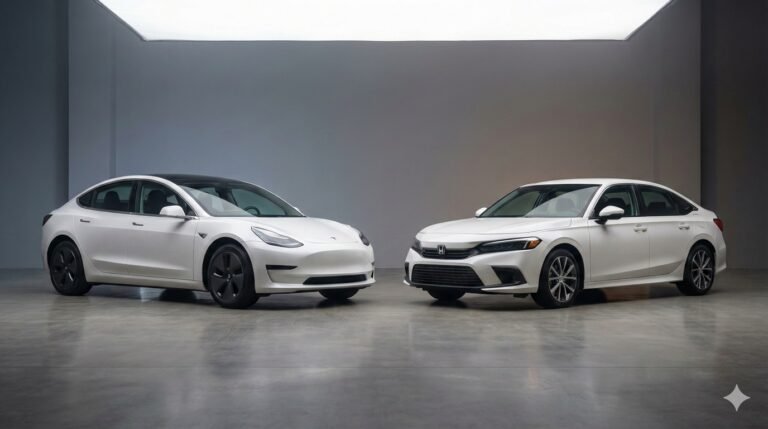
If you’re buying a car in India in 2025, you’re likely facing the ultimate powertrain dilemma: Should you go for the green number plate of a pure electric vehicle (EV) or the practicality of a strong hybrid car? This electric car vs hybrid car India debate has intensified as both technologies mature and become more accessible to Indian buyers.
The Indian automotive market has transformed significantly. We now have proven EVs like the Tata Nexon EV and MG ZS EV alongside highly efficient strong hybrid cars like the Maruti Grand Vitara Intelligent Hybrid and Honda City e:HEV. Both promise to slash your fuel bills dramatically, but they achieve it in fundamentally different ways.
This comprehensive guide analyzes the EV vs hybrid India 2025 debate from every angle—running costs, charging infrastructure, city driving experience, maintenance, and long-term value—to help you make an informed decision for India’s chaotic traffic conditions.
Understanding the Contenders: How Electric and Hybrid Cars Work
Before diving into cost comparisons and real-world performance, it’s crucial to understand what makes these vehicles tick. The term “hybrid” is loosely used in India, so let’s clarify the differences.
What Is an Electric Car (BEV)?
A Battery Electric Vehicle (BEV) runs 100% on battery power stored in a large lithium-ion battery pack. There’s no petrol engine, no fuel tank, and no tailpipe emissions. You must plug it in to recharge, either at home or at public charging stations.
Popular Electric Cars in India:
- Tata Nexon EV (Long Range)
- MG ZS EV
- Mahindra XEV 9e
- MG Windsor EV
- Tata Curvv EV
What Is a Strong Hybrid Car (HEV)?
A Strong Hybrid Electric Vehicle (HEV) combines a petrol engine with one or more electric motors and a self-charging battery. Unlike electric cars, strong hybrids never need to be plugged in. The battery charges automatically through regenerative braking and the petrol engine.
Strong hybrids can run on pure electric power for short distances at low speeds (typically under 40 km/h in traffic), making them exceptionally efficient in city conditions.
Popular Strong Hybrid Cars in India:
- Maruti Grand Vitara Intelligent Hybrid
- Honda City e:HEV
- Toyota Urban Cruiser Hyryder Strong Hybrid
- Honda Elevate Hybrid (upcoming)
Important: Strong Hybrid vs Mild Hybrid
Don’t confuse “strong hybrids” with “mild hybrids” like the standard Maruti Brezza or Ertiga. Mild hybrids provide only a small efficiency boost (10-15%) and cannot drive on electric power alone. Strong hybrids can actually propel the vehicle using only electric motors, delivering fuel efficiency improvements of 30-50% over conventional petrol cars.
Electric Car vs Hybrid Car Comparison: Specs and Pricing
Let’s compare two popular rivals in the ₹15-20 lakh segment that represent the best of both worlds: the Tata Nexon EV (pure electric) and the Honda City e:HEV (strong hybrid).
| Feature | Tata Nexon EV (Long Range) | Honda City Hybrid (e:HEV) |
|---|---|---|
| Powertrain | 40.5 kWh Battery + Electric Motor | 1.5L Petrol + Dual Electric Motors |
| Ex-Showroom Price | ₹14.50 – ₹17.00 Lakh | ₹19.00 – ₹20.50 Lakh |
| Claimed Range/Mileage | 465 km (ARAI Range) | 27.1 km/l (ARAI Mileage) |
| Real-World City Performance | 300-340 km range | 20-24 km/l mileage |
| Running Cost | ₹1.0 – ₹1.5 per km | ₹4.5 – ₹5.5 per km |
| 0-100 km/h | ~8.9 seconds | ~10 seconds |
| Boot Space | 350 liters | 306 liters |
| Charging/Refueling Time | 40 mins (fast charge), 6-8 hours (home) | 5 minutes (petrol pump) |
| GST Rate | 5% | 43% |
| FAME Subsidy Eligible | Previously (now phased out) | No |
Key Price Insight
Electric cars currently enjoy a massive tax advantage in India. EVs attract only 5% GST, while strong hybrids are taxed at 43% (28% GST + 15% cess). This makes electric cars significantly cheaper upfront in most segments, despite hybrids having smaller batteries and simpler powertrains.
Running Cost Comparison: The Real Money Factor
For Indian city dwellers, running costs matter more than purchase price. Let’s break down the actual cost per kilometer for someone driving 40 km daily (1,200 km monthly) in city traffic.
Electric Vehicle Running Costs
Efficiency: 7-8 km per kWh in real-world city traffic
Home Charging Cost: ₹8 per unit (average residential electricity rate)
Cost Per Km: ₹1.00 – ₹1.50
Monthly Cost (1,200 km): ₹1,200 – ₹1,800
Annual Fuel Cost: ₹14,400 – ₹21,600
Public Fast Charging Cost: ₹15-20 per unit
Cost Per Km (Public Charging): ₹2.00 – ₹2.80
Monthly Cost (1,200 km): ₹2,400 – ₹3,360
Strong Hybrid Running Costs
Efficiency: 22-25 km/l in city traffic (with regenerative braking)
Petrol Cost: ₹100 per liter (approximate 2025 rate)
Cost Per Km: ₹4.00 – ₹5.00
Monthly Cost (1,200 km): ₹4,800 – ₹6,000
Annual Fuel Cost: ₹57,600 – ₹72,000
The Verdict on Running Costs
An electric car saves you approximately ₹40,000 – ₹50,000 per year on fuel costs compared to a strong hybrid when charging at home. If you rely primarily on public fast charging, the savings reduce to ₹30,000 – ₹40,000 annually.
For high-mileage users (2,000+ km monthly), electric vehicles deliver unbeatable economics. The fuel savings alone can recover the vehicle cost within 5-6 years compared to traditional petrol cars.
Driving Experience in Indian City Traffic
How do these vehicles actually feel in the notorious stop-and-go traffic of Mumbai, Bangalore, or Delhi?
Electric Cars in City Traffic: Silent Domination
Electric vehicles are purpose-built for urban environments. Here’s why they excel:
Instant Torque Response: Touch the accelerator and power is immediate. This lets you close gaps in traffic effortlessly and navigate crowded intersections with confidence. The Nexon EV’s 245 Nm torque is available from 0 RPM.
Zero Noise, Zero Vibration: Sitting in traffic jams becomes significantly less stressful. There’s no engine rumble, no exhaust smell, and no heat radiating from under the hood.
Regenerative Braking: Lift off the accelerator and the motor acts as a generator, slowing the car while recovering energy. In heavy traffic, you can drive almost entirely on the accelerator, rarely touching the brake pedal. This reduces brake wear and increases efficiency.
Creep Function: Like automatic transmissions, EVs have a creep mode that inches the car forward when you release the brake, making bumper-to-bumper crawling effortless.
Strong Hybrid Cars in City Traffic: Smart Efficiency
Strong hybrids deliver excellent city performance but with different characteristics:
EV Mode at Low Speeds: Below 40 km/h, the Honda City e:HEV runs purely on electric power when the battery has sufficient charge. This makes it silent and smooth in traffic, almost like driving an EV.
Engine Kick-In for Acceleration: When you need quick overtakes or highway merging, the petrol engine starts. The transition is smooth in modern hybrids, but you’ll definitely notice the engine sound and vibration—something absent in pure EVs.
Seamless Complexity: The hybrid system constantly switches between EV mode, engine mode, and hybrid mode based on driving conditions. Modern systems like Honda’s e:HEV manage this intelligently, but it’s not as seamlessly silent as a pure electric car.
Automatic Transmission Feel: All strong hybrids in India use CVT or e-CVT transmissions, providing smooth acceleration without gear shifts.
Performance Comparison
For pure acceleration and performance, electric cars have the edge. The Nexon EV hits 0-100 km/h in 8.9 seconds, outpacing most strong hybrids in the segment. That instant torque makes city driving more engaging and responsive.
However, strong hybrids still deliver respectable performance and are more than adequate for Indian traffic conditions. The real differentiator is the silence and smoothness of EVs in all situations versus the engine noise during hard acceleration in hybrids.
Charging Infrastructure vs Self-Charging Convenience
This is where the hybrid advantage becomes apparent, especially for buyers without dedicated parking.
EV Charging Reality in India 2025
Home Charging (Essential): If you own a house or have dedicated parking with electrical access, home charging transforms EV ownership. Install a 7 kW charger and fully charge overnight for ₹250-300. This covers most daily driving needs.
Apartment Challenges: The biggest barrier to EV adoption in India is apartment living. Getting permission to install a charger, running electrical lines, and managing billing with society committees remains complicated. Without home charging, EV ownership becomes significantly more difficult.
Public Charging Networks: Cities like Delhi, Mumbai, Bangalore, and Pune now have decent fast-charging infrastructure. Companies like Tata Power, Fortum, and Statiq operate thousands of chargers. However:
- Highway charging remains inconsistent outside major routes
- Charger availability and functionality can be unreliable
- Charging times (40-60 minutes for 80% charge) require planning
- Peak-hour queues at popular chargers are common
Range Considerations: Real-world city range of 300-340 km (Nexon EV) is sufficient for most daily use, but long highway trips require charging stops every 250-300 km.
Hybrid Self-Charging Convenience
Strong hybrids offer unmatched convenience:
No Charging Required: Drive it exactly like a normal petrol car. Fill up at any petrol pump in 5 minutes and you’re good for another 600-700 km.
Long-Distance Freedom: Drive from Delhi to Mumbai, Bangalore to Chennai, or anywhere across India without worrying about charger locations or charging times.
Power Cut Immunity: During monsoons or in areas with frequent power cuts, hybrids remain unaffected while EV owners may face charging challenges.
Urban Flexibility: No need for dedicated parking, charger installations, or society permissions. Park anywhere, drive anywhere.
Maintenance and Long-Term Reliability
Understanding maintenance requirements helps calculate true ownership costs over 8-10 years.
Electric Car Maintenance: Simplicity Wins
Electric vehicles have fewer moving parts—no engine oil, no spark plugs, no clutch, no exhaust system, and no complex transmission.
Typical EV Maintenance:
- Tire rotation and replacement (EVs are heavier, wearing tires faster)
- Brake fluid and coolant checks
- Cabin air filter replacement
- Brake pads (last longer due to regenerative braking)
- Software updates (often over-the-air)
Annual Service Cost: ₹2,000 – ₹5,000 for most Indian EVs
Major Concern – Battery Replacement: EV batteries degrade over time, typically losing 10-20% capacity over 8-10 years. Replacement costs range from ₹3-6 lakhs depending on capacity. However, most manufacturers offer 8-year/1.6 lakh km battery warranties, covering this period.
Overall: EVs have the lowest maintenance costs of any powertrain. Over 10 years, you’ll save ₹80,000 – ₹1,20,000 in service costs versus a conventional car.
Strong Hybrid Maintenance: Double Complexity
Hybrids contain both a petrol engine and an electric system, essentially maintaining two powertrains.
Typical Hybrid Maintenance:
- Regular engine oil changes (every 10,000 km)
- Engine air filter and oil filter replacement
- Spark plug replacement
- Transmission fluid changes
- Cooling system maintenance (separate for engine and battery)
- Hybrid system diagnostics
- All standard petrol car maintenance items
Annual Service Cost: ₹6,000 – ₹12,000 depending on the model
Battery Concerns: Hybrid batteries are smaller (1-2 kWh vs 40+ kWh in EVs) and cheaper to replace (₹80,000 – ₹1,50,000). However, they’re also covered by 8-year warranties.
Overall: Hybrids cost more to maintain than EVs but significantly less than conventional petrol cars due to reduced engine wear from electric assistance.
Reliability Track Record
Both technologies have proven reliable in global markets:
- Toyota/Honda hybrids have logged millions of kilometers globally with excellent reliability records
- Tata Nexon EV has become India’s best-selling EV with few reported issues
- Battery technology has matured significantly, with degradation rates better than initially feared
Resale Value and Depreciation
This remains a critical consideration for Indian buyers.
Current Resale Market Scenario
Strong Hybrids: Hold value better in the used car market. Buyers appreciate no charging hassles, and the technology is well-understood. Honda City e:HEV models command 70-75% value after 3 years.
Electric Cars: Face higher depreciation concerns due to:
- Battery degradation anxiety among buyers
- Rapid technology improvements making older EVs seem outdated
- Limited used-car buyer awareness and financing options
- Uncertainty about battery replacement costs
Current data suggests EVs retain 60-65% value after 3 years, though this is improving as the market matures.
Future Outlook
As EV technology standardizes and battery warranties gain trust, resale values should improve. Hybrids may face questions as India potentially moves toward stricter emission norms or EV-only policies in major cities.
Tax Benefits and Government Incentives
Understanding the financial incentives can significantly impact your decision.
Electric Vehicle Benefits
GST Rate: 5% (vs 43% for hybrids) – This alone makes EVs ₹2-4 lakhs cheaper upfront
Road Tax: Most states offer 100% exemption for EVs
Registration Fees: Waived or reduced in many states
FAME Subsidies: The FAME-II scheme has been phased out for most private vehicles, but some state-level incentives remain
Corporate Tax Benefits: Businesses can claim accelerated depreciation on EVs
Green Number Plate: Exemption from odd-even restrictions in Delhi and other cities
Strong Hybrid Benefits
FAME Subsidies: Not eligible
GST Rate: 43% (28% GST + 15% cess)
Road Tax: Some states like Uttar Pradesh offer partial waivers
State Incentives: Limited and inconsistent
Important Note: The government has signaled potential future incentives for strong hybrids to accelerate the transition from conventional vehicles, but nothing concrete as of 2025.
Total Cost of Ownership (5 Years)
Let’s calculate TCO for someone driving 15,000 km annually:
Tata Nexon EV:
- Purchase Price: ₹16,00,000
- Charging Costs (5 years): ₹1,12,500
- Maintenance: ₹15,000
- Insurance (avg): ₹3,00,000
- Total: ₹20,27,500
Honda City Hybrid:
- Purchase Price: ₹19,50,000
- Fuel Costs (5 years): ₹3,37,500
- Maintenance: ₹45,000
- Insurance (avg): ₹3,50,000
- Total: ₹26,82,500
Savings with EV over 5 years: ₹6,55,000
Which Should You Choose? Detailed Buying Advice
Your personal circumstances matter more than any general recommendation.
Choose an Electric Car If:
✅ You have dedicated parking with charging access at home or office
✅ 90% of your driving is within city limits (commute, school runs, shopping)
✅ Daily running is under 150 km and fits within single-charge range
✅ You want maximum running cost savings and can capitalize on cheap home electricity
✅ You enjoy instant performance and appreciate the EV driving experience
✅ Environmental impact matters to you and you want zero tailpipe emissions
✅ You have a second car for long highway trips (ideal for two-car families)
✅ You’re tech-savvy and comfortable with app-based charging and planning
Best For: Urban professionals with fixed parking, IT employees, families with predictable daily routines, eco-conscious buyers, and those who rarely travel beyond city limits.
Choose a Strong Hybrid If:
✅ You don’t have fixed parking or cannot install a home charger
✅ You live in an apartment where society permissions are difficult
✅ You frequently drive 300+ km on highways for work or leisure
✅ Range anxiety concerns you and you don’t want to plan trips around chargers
✅ You want better resale value in the current used car market
✅ You need one car that does everything without charging infrastructure dependency
✅ You drive through areas with unreliable power supply
✅ You prioritize convenience over maximum cost savings
Best For: Sales professionals with irregular travel, families taking frequent highway trips, apartment dwellers without charging access, buyers in tier-2/3 cities with limited charging infrastructure, and those prioritizing flexibility.
Special Scenarios and Considerations
Scenario 1: Apartment Dweller in Bangalore
Without home charging, owning an EV becomes challenging. While Bangalore has decent public charging, relying on it daily adds time and inconvenience. A strong hybrid makes more sense unless your office/workplace offers charging facilities.
Scenario 2: Family with Two Cars
Perfect EV use case. Use the EV for daily city commutes (cheaper running costs) and keep a conventional car/hybrid for weekend getaways and long trips.
Scenario 3: High-Mileage Cab/Uber Driver
Electric cars deliver unbeatable economics for high-mileage commercial use. Drivers covering 150-200 km daily can save ₹10,000+ monthly on fuel. The Nexon EV and MG ZS EV are popular among commercial operators.
Scenario 4: Budget-Conscious First-Time Buyer
If minimizing total cost is the goal, EVs win decisively when you have home charging. The ₹2-4 lakh lower purchase price plus ₹40,000+ annual fuel savings make EVs economically superior.
Future-Proofing Your Decision
Consider what the next 5-10 years might bring:
EV Future:
- Charging infrastructure will expand significantly
- Battery costs will decrease while range increases
- More model options across segments
- Potential city-center restrictions on non-EVs
- Improved resale markets as EVs become mainstream
Hybrid Future:
- Possible increased taxation as government pushes EV adoption
- Strong demand will continue during the transition period
- May become the preferred choice for tier-2/3 cities
- Uncertainty about long-term government policy support
Frequently Asked Questions
Q1: Is a hybrid car cheaper to run than an electric car in India?
No. Electric cars cost approximately ₹1.00-₹1.50 per km when charging at home, while strong hybrids cost ₹4.00-₹5.00 per km. However, hybrids are still significantly cheaper than conventional petrol cars (₹9-₹10 per km). The EV advantage disappears if you rely solely on expensive public fast charging.
Q2: Which has higher maintenance costs, EV or hybrid?
Strong hybrids have higher maintenance costs because they contain both a petrol engine requiring regular oil changes and servicing, plus electric components. EVs have fewer moving parts (no engine, transmission, or exhaust) and typically need only ₹2,000-₹5,000 annual maintenance versus ₹6,000-₹12,000 for hybrids.
Q3: Do hybrid cars get government subsidies in India?
As of 2025, strong hybrids do not receive FAME subsidies from the central government. However, some states like Uttar Pradesh offer road tax waivers. The real disadvantage is the 43% GST on hybrids versus just 5% GST on EVs, making hybrids significantly more expensive at purchase.
Q4: Can hybrid cars run without petrol?
No. Strong hybrids can drive short distances (typically 1-2 km) on electric power alone at low speeds, but they ultimately rely on the petrol engine to charge the battery and provide power at higher speeds. You must regularly refuel them like conventional cars. They are “self-charging” but not “plug-free driving.”
Q5: How long do EV and hybrid batteries last?
Both modern EVs and strong hybrids come with battery warranties of 8 years or 1.6 lakh km. Real-world data suggests EV batteries retain 80-90% capacity after 8-10 years. Hybrid batteries are smaller (1-2 kWh vs 40+ kWh) and cheaper to replace if needed. Battery technology has proven far more durable than early concerns suggested.
Q6: What happens to EV charging during power cuts?
Power cuts don’t affect EVs as much as feared. Most urban areas have reliable power, and you can charge during available hours. Many EV owners install inverter-based backup systems. Alternatively, public fast chargers run on dedicated power lines with backup generators and are rarely affected.
Q7: Can I install an EV charger in my apartment parking?
This varies by society and state regulations. You’ll need:
- Society permission and NOC
- Dedicated parking with electrical access
- Electrician assessment and installation
- Individual meter or proper billing arrangement
Many modern apartments are becoming EV-ready, but older complexes may pose challenges. Check with your society before purchasing an EV.
Q8: Are electric cars more expensive to insure?
Yes, slightly. EVs cost 5-10% more to insure due to higher vehicle value and specialized parts. However, this is offset by lower maintenance and running costs. The difference amounts to ₹3,000-₹5,000 annually.
Final Verdict: Electric Car vs Hybrid Car India
There’s no universal winner in the electric car vs hybrid car India debate. The right choice depends entirely on your driving patterns, parking situation, and budget.
Electric cars dominate when you have home charging and primarily drive within city limits. The combination of lower purchase price (thanks to 5% GST), dramatically lower running costs (₹1/km vs ₹4-5/km), and minimal maintenance makes them the economically superior choice for urban commuters.
Strong hybrids win when infrastructure is a concern. If you can’t install a home charger, frequently travel long distances, or want the convenience of refueling anywhere in 5 minutes, hybrids offer the best balance of efficiency and practicality.
For most Indian city dwellers with dedicated parking and predictable daily routines under 100 km, an electric car makes tremendous financial sense. For everyone else, strong hybrids provide an excellent stepping stone toward electrification without the infrastructure compromises.
The good news? Both technologies are mature, reliable, and significantly better for your wallet and the environment than conventional petrol cars. You can’t make a wrong choice—only the one that fits your life better.
Related Resources
- Tata Nexon EV Detailed Review: Real-World Range Test
- Top 5 Upcoming Electric Cars in India 2025
- Complete Guide: Installing an EV Home Charger in Indian Apartments
- Maruti Grand Vitara Hybrid vs Petrol: Which Variant to Buy?
- EV Charging Station Finder: Best Apps for Indian Drivers
- Electric Car Insurance in India: Complete Cost Breakdown