
Electric vehicles are gaining popularity rapidly, but for many new buyers understand about AC vs DC Fast Charging..? EV charging still feels confusing right. Terms like AC charging, DC fast charging, kilowatts, and connectors often make charging sound far more complex than filling fuel.
In reality, EV charging is simple once you understand one core concept:
All EV batteries store electricity as DC (Direct Current).
The difference between AC and DC charging lies in where the electricity is converted.
This article explains how EV charging really works, the difference between AC and DC fast charging, their cost, speed, impact on battery life, and which option is best for you.
Table of Contents
The Basics: How an Electric Vehicle Charges
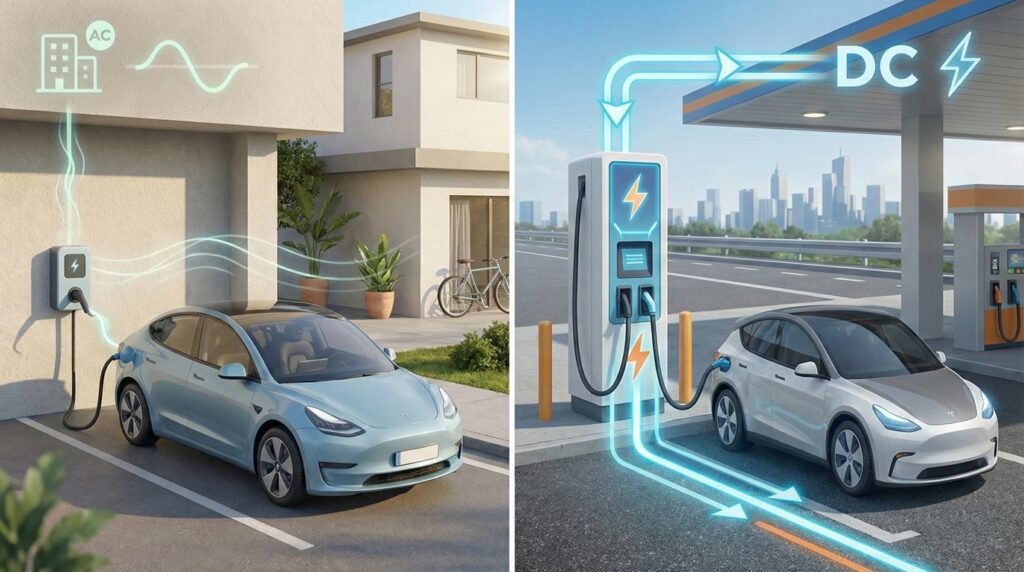
When you connect your electric vehicle (EV) to a charger, electricity passes through the charging cable and is stored in the battery pack. The car’s on-board circuit controls this process by converting the incoming current in the battery. To safeguard the battery, maximize charging speed, and guarantee long-term durability, this procedure is meticulously regulated.
The type and wattage of the outlet determine the various charging levels. For home use and overnight charging schedules, a standard wall outlet with a slow-charging AC outlet is used for home charging. However, public EV chargers use fast DC chargers, which take around two hours to fully charge an EV. The charging speed also depends on many factors such as battery size, charger capacity and vehicle’s current state of charge.
What Is AC Charging?
How AC Charging Works
AC charging is the most common way to charge an EV. In AC charging, natural AC flows from the charger to the vehicle. Inside the EV, an onboard charger converts this AC power into DC (Direct Current), which is what the battery actually stores. This conversion is limited by the onboard charger’s capacity. AC charging is generally slower than fast DC charging.
AC charging is ideal for daily use and overnight charging. It’s gentler on the battery, more affordable to install, and perfectly suited for situations where the car can remain plugged in for several hours. Most home chargers and public slow chargers use AC power, making it the backbone of everyday EV charging.
Where AC Charging Is Used
- Home charging
- Office charging
- Apartment complexes
- Public chargers
AC charging is the most common and most affordable form of EV charging.
Typical AC Charging Speeds
| AC Charger Type | Power Output | Approx. Charging Time |
|---|---|---|
| Basic socket | 2.3–3.3 kW | 12–16 hours |
| Wallbox | 7.4 kW | 6–8 hours |
| Public AC | 11 kW | 4–6 hours |
| High-power AC | 22 kW* | 3–4 hours |
*Only works if the EV supports 22 kW onboard charging.
Important: AC charging speed is limited by your EV’s onboard charger, not the charger itself.
What Is DC Fast Charging?
DC fast charging is a high-power charging method that allows electric vehicles to recharge much more quickly than regular AC charging.
Unlike AC charging, DC fast chargers convert electricity into direct current (DC) outside the vehicle and send it straight to the battery. This bypasses the car’s onboard charger, enabling much higher power delivery. As a result, DC fast charging can add a large amount of range in a short time—often charging an EV from around 20% to 80% in 20–40 minutes, depending on the vehicle and charger capacity.
DC fast charging is commonly found at highways, public charging hubs, and commercial locations, making it ideal for long trips and quick top-ups. To protect the battery, the charging speed automatically slows down as the battery fills up or heats up. While extremely convenient, DC fast charging is best used when needed, as frequent use can put more stress on the battery compared to slower AC charging.
Where DC Fast Charging Is Used
- Highways and expressways
- Fast-charging corridors
- Public charging hubs
- Long-distance travel routes
DC fast charging is designed for speed and convenience, not daily use.
Typical DC Charging Speeds
| DC Charger Type | Power Output | 10–80% Charge Time |
|---|---|---|
| DC Fast | 25–50 kW | 60–90 minutes |
| DC Rapid | 100–150 kW | 30–45 minutes |
| Ultra-Fast DC | 250–350 kW | 15–25 minutes* |
*Only supported by select high-end EVs.
Most EVs slow down charging after 80% to protect battery health.
AC vs DC Charging: Key Differences Explained
| Feature | AC Charging | DC Fast Charging |
|---|---|---|
| Power supplied | AC | DC |
| Conversion location | Inside the EV | Inside the charger |
| Charging speed | Slow to moderate | Very fast |
| Cost per unit | Low | High |
| Battery stress | Minimal | Higher if overused |
| Ideal use | Daily charging | Long trips & emergencies |
What Really Affects EV Charging Speed?
Charging speed is not determined by the charger alone.
Key factors include:
- Battery capacity (kWh)
- State of charge (SOC) – slower above 80%
- Maximum charging limit of the EV
- Battery temperature & cooling system
- Charger power rating
Even on a 150 kW charger, an EV limited to 50 kW will charge at only 50 kW.
Cost Comparison: AC vs DC Charging
AC Charging Costs
- Cheapest charging option
- Ideal for home use
- Lower electricity tariffs
- Minimal infrastructure cost
DC Fast Charging Costs
- 2–4 times more expensive per unit
- Includes infrastructure, demand charges, and maintenance
- Best used occasionally
Is DC Fast Charging Bad for EV Batteries?
This is one of the most common EV myths.
The Truth:
- Occasional DC fast charging is completely safe
- Modern EVs use advanced Battery Management Systems (BMS)
- Battery degradation increases only with frequent, repeated fast charging
Best practice:
- Use AC charging for daily needs
- Use DC fast charging for travel or urgency
This balance maximizes battery life.
Which EV Charging Option Is Best for You?
Choose AC Charging if:
- You have home or workplace charging
- You drive daily short to medium distances
- You want lower running costs
- You want maximum battery longevity
Choose DC Fast Charging if:
- You travel long distances
- You need quick top-ups
- You don’t have access to home charging
Common Myths About EV Charging
Myth: Fast charging always damages batteries
Reality: Only excessive, continuous use can accelerate wear
Myth: Bigger charger means faster charging
Reality: EV charging speed is limited by the car
Myth: EV charging is complicated
Reality: It’s simpler than petrol once understood
Conclusion
EV charging is far simpler than it appears.
- AC charging is affordable, gentle on batteries, and ideal for daily use
- DC fast charging is powerful, convenient, and perfect for long journeys
Understanding how both work allows you to charge smarter, save money, and protect your EV battery.
As EV adoption grows, knowing the difference between AC and DC charging isn’t optional—it’s essential.
Frequently Asked Questions (FAQs)
Can I use DC fast charging every day?
You can, but daily AC charging is recommended for lower cost and better battery health.
Why does EV charging slow down after 80%?
To prevent overheating and extend battery life.
Is overnight home charging safe?
Yes. Certified chargers include surge protection, temperature monitoring, and auto cut-off.
Does fast charging affect EV warranty?
No. EV warranties are designed assuming occasional fast charging.
Which charging type is best for battery life?
Regular AC charging with limited DC fast charging.