Are you considering making the switch to an electric vehicle in 2025, but wondering about its true environmental impact? It’s a common and incredibly important question! In a world increasingly focused on sustainability, understanding the complete picture of electric cars emissions vs gas emissions – from manufacturing to the end of a vehicle’s life – is crucial for making an informed decision. Many people ask, “Are electric cars cleaner?” The short answer is a yes. In this comprehensive guide, we’ll dive deep into the data, debunk myths, and reveal why EV lifecycle discharge are significantly lower than those of traditional gasoline cars, leading to substantial reductions in electric vehicle pollution. We’ll explore everything from the initial carbon footprint of battery production to the long-term benefits of zero tailpipe output, helping you understand the real impact of your next car purchase.
Key Takeaways
- Significant Lifetime Emissions Reduction: Battery electric cars sold in 2025 produce an impressive 73% less life-cycle greenhouse gas vapors compared to their gasoline counterparts.
- Rapid Environmental Payback: Despite higher initial manufacturing output, EVs become cleaner than comparable gas cars in less than two years due to their superior energy efficiency.
- Zero Tailpipe Output: Electric vehicles eliminate smog and NOx pollution at the tailpipe, a critical factor since over 50% of a gasoline car’s lifetime emissions come from daily driving.
- EVs are Cleaner Everywhere: Research from 2025 confirms that battery electric vehicles have lower lifetime emissions than all other vehicle types across the entire United States.
Electric vs. Gasoline Carbon footprints
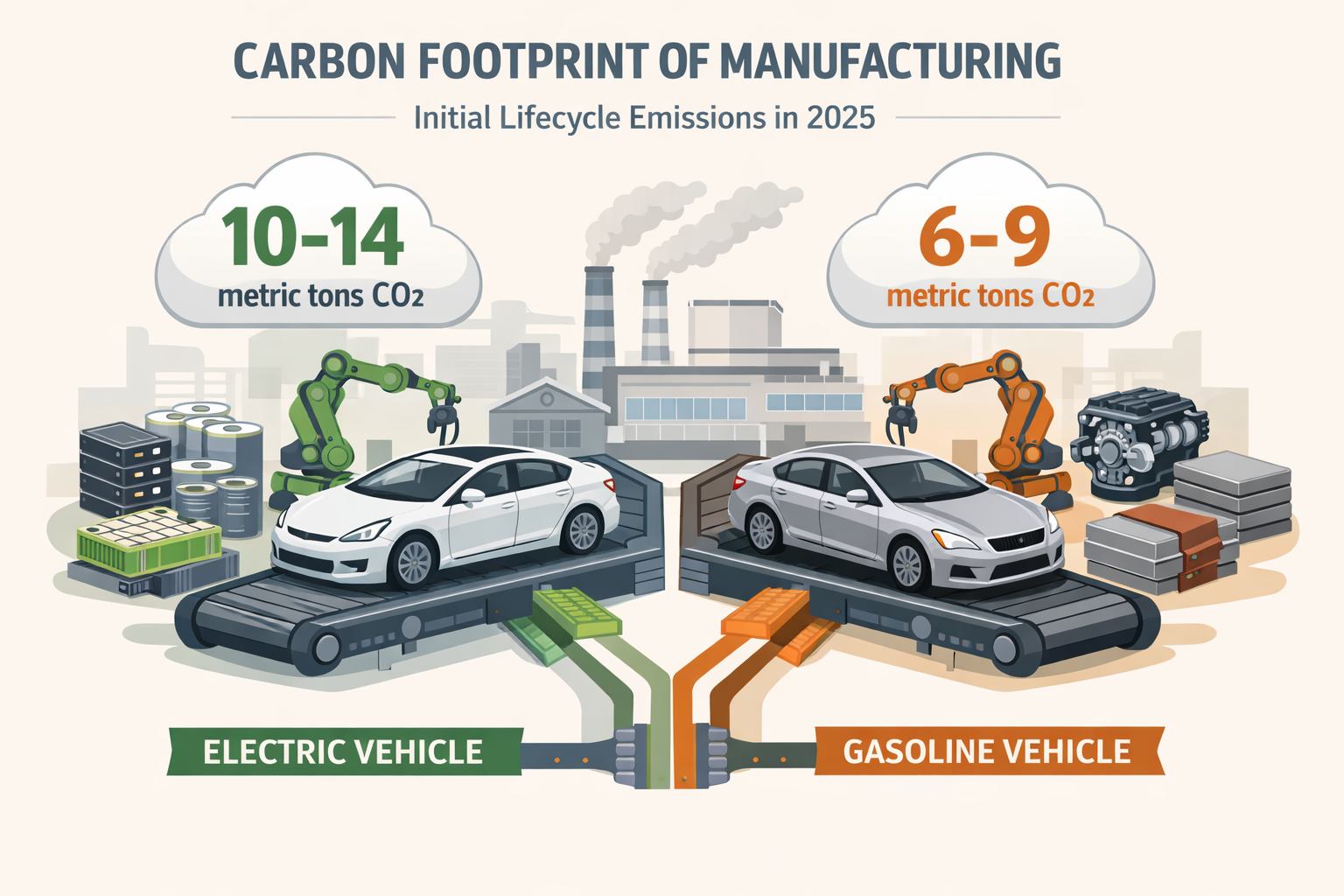
When we talk about electric cars vs gas emissions, a common point of discussion revolves around the manufacturing process. It’s true that building an electric vehicle, particularly its battery, requires more energy and resources upfront compared to a traditional gasoline car. Let’s break down the numbers.
The Upfront Carbon Cost
Manufacturing an electric vehicle typically creates between 10 to 14 metric tons of CO2. This higher figure is primarily due to the energy-intensive process of producing EV batteries, which involves mining, refining, and assembling various materials like lithium, cobalt, and nickel. For comparison, manufacturing a gasoline sedan produces approximately 6 to 9 metric tons of CO2.
It might seem like a disadvantage for EVs at first glance. However, this is only part of the story. Think of it like a marathon – the gasoline car gets a head start, but the electric car is built for efficiency and quickly closes the gap.
Why the Battery Makes a Difference
The battery is the heaviest and most complex component unique to EVs, and its production footprint is significant. The processes involved in extracting raw materials and then manufacturing the sophisticated cells and battery packs contribute substantially to the initial EV lifecycle byproducts. However, advancements in battery technology and manufacturing processes are continuously working to reduce this impact. For example, some manufacturers are using cleaner energy sources in their factories, and efforts are underway to make battery recycling more efficient, which can recover valuable materials and reduce the need for new mining.
“A new electric car produces an average of 110 grams of CO2 per mile over its lifetime, compared to 410 grams for a new gasoline car.”
This quote gives us a glimpse into the bigger picture. While the initial manufacturing discharge of waste for an EV are higher, their subsequent operational efficiency dramatically shifts the balance over the vehicle’s lifespan.
The Daily Drive: Operational car emissions
Zero Tailpipe Emissions: A Game Changer
The most obvious advantage of electric vehicles is their zero tailpipe output. This means:
- No Smog: Traditional gasoline cars release nitrogen oxides (NOx) and volatile organic compounds (VOCs) that react in sunlight to form smog, a serious air pollutant that harms respiratory health. EVs eliminate this.
- No Greenhouse Gases (Directly): While gasoline cars directly pump CO₂ into the atmosphere every time they burn fuel, EVs produce none of these gases from the vehicle itself.
Consider this striking fact: over 50% of a gasoline car’s lifetime byproduce come from daily use and driving. This massive chunk of pollution is completely absent from the operational phase of an electric car. This is a critical factor when discussing are electric cars are cleaner over their lifespan.
The Power Source Matters
While EVs have zero tailpipe emissions, the electricity they use to charge has an upstream carbon footprint. This is where the concept of “grid decarbonization” comes into play. The cleaner the electricity grid (i.e., the more it relies on renewable sources like solar, wind, and hydropower), the lower the operational emissions of an EV.
The good news? Grids worldwide are getting cleaner every year, and this trend is only accelerating in 2025. This means that an EV bought today will become even cleaner over its lifetime as the energy sources supplying it become more sustainable.
The impact of grid cleanliness can be significant:
- In a city like Seattle, which benefits from hydropower-based electricity, adding 2,500 pounds of cargo to an electric pickup increases pollution by only 1% per mile.
- In contrast, in Cincinnati, where electricity relies more on fossil fuels, the same cargo load increases pollution by 20% per mile.
This highlights that while EVs are always cleaner, their total battery electric vehicle carbon footprint during operation is influenced by the local energy mix. However, even with a fossil-fuel-heavy grid, EVs are still a better choice due to their superior efficiency. You can explore new EV launches and reviews on our site.
The Full Picture: Lifetime waste– Are Electric Cars Cleaner?
To truly answer the question, “Are electric cars cleaner?” we must look at the entire lifespan of a vehicle – from the initial mining of materials and manufacturing to its daily operation and eventual disposal or recycling. This is the EV lifecycle waste analysis.
Comprehensive Lifetime Analysis
Groundbreaking research published in Environmental Science and Technology in 2025 confirms what many proponents of EVs have long asserted: battery electric vehicles have lower lifetime pollution than all other vehicle types in every county across the contiguous United States. This isn’t just a regional benefit; it’s a nationwide advantage.
Let’s look at the numbers:
| Vehicle Type | Average Lifetime CO2 Emissions (Metric Tons) |
|---|---|
| Gasoline Car | Approximately 76 metric tons |
| Electric Vehicle | Approximately 37 metric tons |
This table clearly illustrates the massive difference. Over a complete lifetime (manufacturing, operation, and upstream pollutants), a gas car produces approximately 76 metric tons of CO2, while an EV produces approximately 37 metric tons. That’s a reduction of more than 50%!
The Rapid Payback Period
Despite their higher initial manufacturing pollution, electric vehicles become cleaner than comparable gas cars in less than 2 years. This rapid “payback” period is primarily because EVs are approximately four times more energy-efficient than gasoline cars. They convert a much higher percentage of their energy into motion, losing less as waste heat.
This means that within a couple of years of ownership, your EV has already offset its manufacturing deficit and is actively contributing to significantly lower overall emissions compared to a gasoline vehicle driven for the same period. For more detailed comparisons between EVs and other vehicle types, check out our article on electric car vs hybrid car.
Comparing Against Other “Green” Options
Sometimes, people consider hybrids or plug-in hybrids (PHEVs) as steps towards electrification. While these vehicles do offer some improvements, they pale in comparison to the electric vehicle pollution reduction offered by full battery electric vehicles (BEVs).
Here’s how they stack up in terms of emissions reductions compared to gasoline vehicles:
- Hybrid Vehicles: Offer only 20% lower lifetime pollution than gasoline cars.
- Plug-in Hybrids (PHEV): Offer just 30% lower pollution.
- Battery Electric Vehicles (BEVs): Deliver a massive 71-73% lower emissions compared to gasoline vehicles.
This data unequivocally shows that BEVs are the clear winner for electric cars vs gas emissions when it comes to overall lifetime environmental impact. The difference between a BEV and a hybrid or PHEV is far more substantial than the difference between a hybrid/PHEV and a traditional gasoline car.
The Impact of Vehicle Type: Sedans vs. Pickups (H3)
The discussion around electric cars vs gas emissions isn’t just about the powertrain; the type of vehicle also plays a significant role. It’s often assumed that larger vehicles, even electric ones, must have a much higher impact. While size does matter, the relative advantage of electrification remains strong, especially in categories with historically high pollution.
Electric Sedans: The Greenest Choice
When it comes to minimizing your carbon footprint, electric sedans lead the pack. They have the lowest overall emissions at just 81 grams of CO2 per mile over their lifetime. This makes them an exceptionally clean option for personal transport.
Electric Pickups: A Powerful Reduction
Pickups and SUVs are some of the most popular, and often the most polluting, vehicle segments on the road. This is where electric models make an especially dramatic difference. Gasoline-powered pickups have the greatest climate impact at 486 grams of CO2 per mile.
However, electric pickups are transforming this picture:
- Electric pickups emit 75% lower pollutants than gasoline pickups.
- Even when loaded with a substantial 2,500 pounds of cargo, electric pickups emit less than 30% of what an empty gasoline pickup emits.
This means that switching to an electric pickup, like a potential Mahindra XEV-9S, represents a monumental step towards electric vehicle pollution reduction for those who need the utility of a truck. The environmental savings are even greater here than with smaller vehicles, highlighting the broad applicability of EV technology for making the entire transport sector cleaner. For more specific EV reviews, visit our reviews section.
Addressing Common Concerns About EV Lifecycle byproduce
As an expert SEO content strategist, I know there are always lingering questions and concerns. Let’s tackle some of the common myths and delve deeper into aspects of EV lifecycle waste that sometimes confuse potential EV buyers.
Battery Production and Raw Materials
One frequent concern revolves around the mining of raw materials for EV batteries, such as lithium, cobalt, and nickel. Mining indeed has environmental impacts. However, it’s essential to compare this to the entire lifecycle of fossil fuels.
- Fossil Fuel Extraction: The extraction, refining, and transportation of gasoline and diesel are incredibly energy-intensive and environmentally damaging processes, leading to oil spills, habitat destruction, and significant greenhouse gas production.
- Recycling and Second Life: EV batteries are becoming increasingly recyclable, allowing for the recovery of valuable materials and reducing the need for new mining. Furthermore, many EV batteries can have a “second life” as stationary energy storage units after their automotive life, further extending their utility and reducing waste.
The environmental burden of battery production, while present, is a one-time impact that is rapidly offset by the zero tailpipe emissions during operation. The continuous extraction and burning of fossil fuels represent an ongoing, ever-present environmental cost.
End-of-Life Vehicle Management
What happens to an EV at the end of its life? This is another aspect of EV lifecycle emissions. Just like traditional cars, EVs are subject to end-of-life regulations.
- Battery Recycling: As mentioned, battery recycling infrastructure is growing. Specialized facilities can safely dismantle batteries and recover valuable materials. This helps close the loop and reduces the overall environmental footprint.
- Other Components: The rest of the EV, including steel, aluminum, plastics, and electronics, can be recycled just like parts from a gasoline car.
The industry is rapidly innovating to make the entire lifecycle, including disposal, as sustainable as possible.
The True Cost of Gasoline Production
When evaluating electric cars vs gas emissions, we often forget the “upstream” emissions of gasoline. It’s not just about what comes out of the tailpipe. Consider:
- Oil Exploration and Drilling: Energy-intensive and environmentally disruptive.
- Transportation of Crude Oil: Via pipelines, tankers, and trucks, with risks of spills.
- Refining: A highly energy-intensive process that releases significant greenhouse gases and pollutants.
- Transportation of Refined Fuel: To gas stations.
The Future is Electric: What This Means for You in 2025
The data is clear: in 2025, electric vehicles are demonstrably cleaner than gasoline cars across their entire lifecycle. From significantly lower lifetime emissions to zero tailpipe pollution, the environmental benefits are compelling.
Why Choose an EV Now?
- Reduce Your Carbon Footprint: Make a tangible difference in reducing greenhouse gas emissions and combating climate change.
- Cleaner Air: Contribute to better air quality in your community by eliminating harmful tailpipe emissions.
- Lower Running Costs: Beyond environmental benefits, EVs often have lower fuel and maintenance costs.
- Technological Advancements: EVs are constantly improving in range, charging speed, and performance.
- Government Incentives: Many regions offer incentives for EV purchases, making them even more accessible.
Conclusion
The debate between electric cars vs gas emissions has been thoroughly analyzed, and the scientific consensus in 2025 is unequivocal: electric vehicles are a significantly cleaner alternative. While the initial manufacturing of EV batteries does carry a higher carbon footprint, this is rapidly offset by the dramatic reduction in operational emissions, leading to a much lower EV lifecycle emissions total. With zero tailpipe emissions, EVs play a crucial role in electric vehicle pollution reduction, cleaning our air, and slowing climate change.
From electric sedans boasting the lowest overall emissions to powerful electric pickups offering monumental reductions compared to their gasoline counterparts, the environmental benefits span across vehicle segments. As grids become cleaner and battery technology advances, the advantage of EVs will only continue to grow.
For you, the prospective EV buyer, this means that choosing an electric car in 2025 isn’t just a smart personal finance decision – it’s a powerful step towards a more sustainable future. You’re not just buying a car, you’re investing in cleaner air, a healthier planet, and a more sustainable transportation system. Embrace the electric revolution with confidence, knowing you’re making a real positive impact.