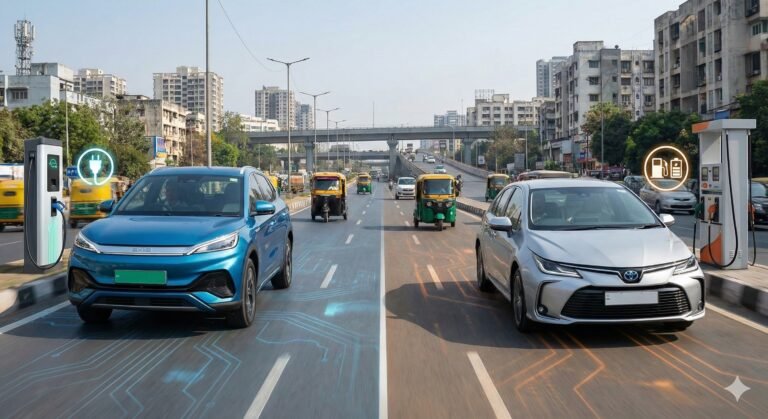
One of the most important factors people consider when buying an EV vehicle is the price. At first glance, EVs usually appear more expensive than comparable gasoline-engined cars, thus, people tend to have questions about affordability and value. However, the real price difference between EVs and gasoline vehicles is more than the sticker price alone. To understand it properly, we must look beyond showroom price and consider long-term ownership costs.
Upfront Purchase Cost
In most markets, EVs currently have a higher on-road purchase price compared to gasoline cars in the same segment. This is mainly due to the cost of lithium-ion batteries, which is one of the most expensive components of an electric vehicle. Even though battery prices have steadily declined over the years, they still add significant value to EV manufacturing.
For example, an electric car may cost noticeably more than its petrol equivalent at launch. However, this gap is gradually narrowing as battery technology improves, production scales up, and competition in the EV market increases. In many regions, government incentives, tax benefits, and subsidies further help reduce the initial cost difference.
Fuel and Energy Costs
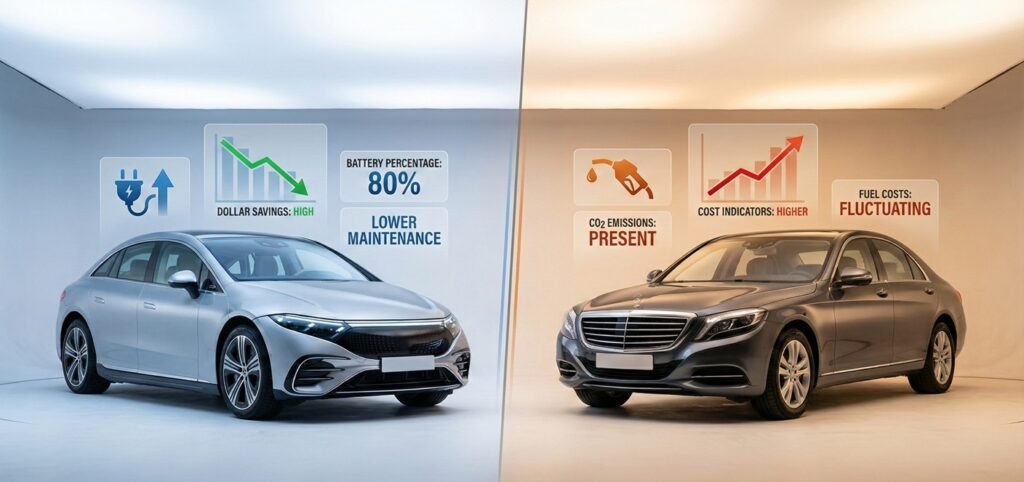
Running cost is the area where EVs outperform gasoline cars. Electricity is generally far cheaper than petrol or diesel on a per-kilometer basis. Charging an EV at home, especially during off-peak hours, can cost a fraction of what it takes to refuel a conventional car.
Over time, this difference becomes substantial. Drivers who cover high annual mileage often find that the savings on fuel alone can offset the higher purchase price of an EV within a few years. Gasoline vehicles, by contrast, remain vulnerable to fuel price fluctuations and long-term increases in oil costs.
Maintenance and Servicing
Maintenance is another area where EVs tend to be more economical. Electric vehicles have fewer moving parts compared to gasoline cars. There are no oil changes, spark plugs, exhaust systems, or complex transmissions to maintain. Brake wear is also reduced due to regenerative braking, which helps recharge the battery.
As a result, EV owners typically experience lower servicing and maintenance expenses over the vehicle’s lifetime. Gasoline cars, while often cheaper to buy initially, accumulate higher maintenance costs as engines age and components wear out.
Total Cost of Ownership
When evaluating the true price difference, the total cost of ownership (TCO) provides a more accurate comparison than upfront cost alone. TCO includes purchase price, fuel or electricity costs, maintenance, insurance, and resale value.
In many cases, EVs become cheaper—over a 5–8 year ownership period, particularly for urban drivers and daily commuters. Gasoline cars may still make financial sense for buyers with low annual usage or limited access to charging infrastructure, but the gap is closing rapidly.
Real-life situation
Let’s take the new Tata Curvv and the Tata Curvv EV as an example. We will be comparing the top models of both of these cars, which will have mostly the same features. The only difference will be the energy sources of these two vehicles.
| Tata Curvv Ex-Showroom Price(Accomplished Plus Petrol Variant – Delhi) | ₹18,60,890 |
| Tata Curvv EV Ex-Showroom Price(Empowered Plus A 55 Variant – Delhi) | ₹21,99,000 |
We notice that the government of India provides subsidy on the purchase of electric vehicles, showing a huge difference in the registration cost of both cars.
| Registration Cost for Tata Curvv(Delhi) | ₹1,60,871 |
| Registration Cost for Tata Curvv EV(Delhi) | ₹60,525 |
However, there is not a huge difference in the tax collected on both the cars. Now adding up all the extra ammount, we get the On-Road price for both the vehicles
| Tata Curvv On-Road Price | ₹21,21,458 |
| Tata Curvv EV On-Road Price | ₹23,65,687 |
Now adding the running cost for both the vehicles
| Tata Curvv running cost(₹4/km) | ₹4,03,220 |
| Tata Curvv EV(₹1.22/km) | ₹1,22,324 |
Seeing this, the Tata Curvv EV is much more efficient and helps the customer to save approx ₹3 lacs, which includes the running cost for 5 years, given that the consumer has a running of 25000km/year.
Resale Value and Long-Term Outlook
Historically, concerns about battery degradation affected EV resale values. Today, improved battery durability, longer warranties, and better consumer awareness have strengthened confidence in used EVs. Meanwhile, tightening emissions regulations and the global shift toward electrification may gradually reduce the long-term appeal of gasoline cars.
As battery costs continue to fall and charging infrastructure expands, the upfront price difference between EVs and gasoline cars is expected to shrink further. In the coming years, EVs may not only be cheaper to own but also cheaper to buy.
Bottom Line
While electric vehicles often cost more upfront than gasoline cars, this price difference does not tell the full story. Lower fuel expenses, reduced maintenance costs, and long-term savings can significantly offset the initial premium. For many buyers, the decision is no longer just about purchase price, but about overall value, efficiency, and future readiness.
As the automotive industry evolves, the question is shifting from “Why are EVs more expensive?” to “How long before they become the more economical choice by default?”